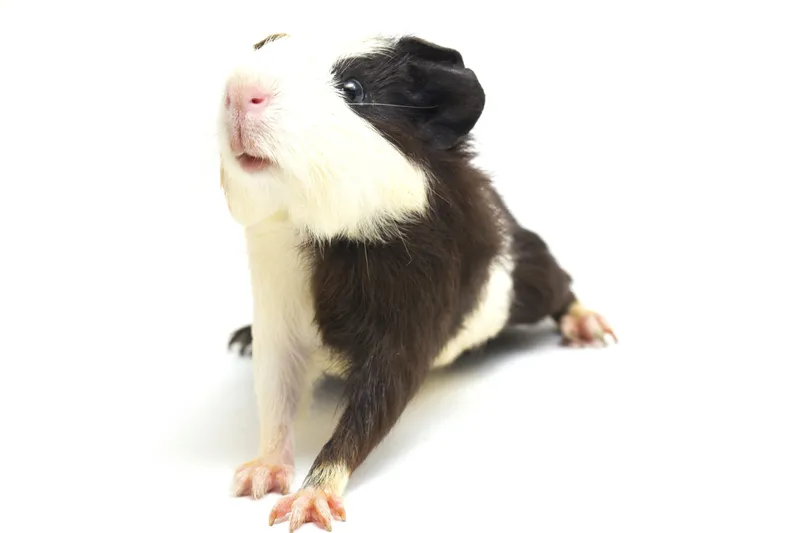
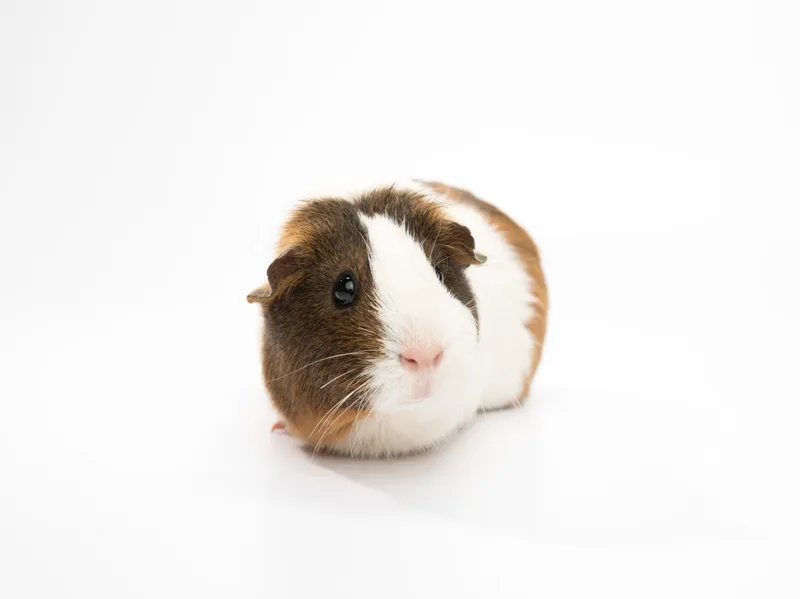
Guinea pig
Cavia porcellus
Very shy and easily stressed animal.
Overview & key figures
Regulations
Companion animal
ℹ️OPAn: mandatory group housing (min. 2), minimum space and shelters. Professional trade: competence certificate. Transport per FSVO rules.
Lifespan
from 5 to 8years
Adult weight
from 800 to 1000g
ℹ️800 g - 1 kg
Lifestyle
Diurnal
Body temperature
from 37.2 to 39.5°C
Sexual maturity
from 42 to 70days
ℹ️10 weeks (male), 6 weeks (female)
Gestation
from 68 to 68days
Litter / clutch size
from 2 to 4
Habitat & environment
Type of housing
Semi-free range, enclosure or large cage with regular out-of-cage time, sheltered from drafts
Substrate & bedding
Towels, DryBed®/VetBed®, Toftbo® mats, yoga mat or blanket. Plant-based bedding: Nullodor® (fir wood), hemp, recycled paper. Avoid cedar and pine.
Exercise & outings
At least two hours per day indoors or in an outdoor enclosure (temperature permitting) to stimulate gut transit and prevent obesity
Required equipment
- ✓ Hideout (small house, cardboard box, tunnel)
- ✓ Hay rack
- ✓ Heavy food bowl
- ✓ Heavy water bowl (refresh daily). Low-lime/calcium water: risk of urinary stones.
Technical parameters
| Ambient temperature | 18–24 °C |
Nutrition
Recommended breakdown
- Hay & grass (staple food) 80 %
- Vegetables & greens 20 %
Daily base
Strict herbivore. Hay/grass ad libitum (twice the animal's body volume per day). Ensures dental wear and good digestibility.
🌿 Plants & herbs
🥕 Vegetables & greens
100 g/kg/day, at least 3 different kinds per day. Favour vitamin-C-rich vegetables and leafy greens. Warning: Tomato, spinach and vitamin-C-rich fruits should be given in moderation (small quantities), as they are high in calcium and sugar.
Supplements & pellets
Pellets (uniform shape only — never seed mixes / muesli) should be given in small quantity: maximum 20 g/kg of body weight per day. Not essential; in excess they favour dental malocclusion, overweight and digestive problems: prioritise hay and greens.
- 🟤 Pellets
Treats
Not essential, rich in carbohydrates and sugars. Considered as treats. Can be given as enrichment, in small quantities, 1 to 2 times per week.
Vitamin C
The guinea pig cannot synthesise vitamin C (like humans). To prevent scurvy — the consequence of a deficiency — vitamin C must be given orally every day. Beware: it degrades quickly in drinking water! During growth, pregnancy or illness, requirements double.
To avoid
- 🫘 Soy
- 🥑 Avocado
- 🥬 White Cabbage
- 🧅 Onion
- 🧄 Garlic
- 🌿 Sorrel
- 🥔 Potato
- 🍅 Tomato Leaves
- 🧅 Leek
- 🌿 Rhubarb
- 🍊 Peels
- 🍞 Bread
- 🍬 Sweets
- 🍫 Chocolate
- 🥣 Cereal Bars
- 🍇 Dried Fruits
Behaviour & socialisation
Social life
Social animal that needs conspecifics to live peacefully. Watch for male-male grouping (fighting). Do not house with rabbits (Bordetella transmission risk).
Activity cycle: Diurnal
Enrichment
- Tunnels
- Safe exploration
- Daily out-of-cage time
Health & prevention
Preventive medicine
Deworming required if allowed outdoors or symptomatic. Annual check-up recommended.
Vaccination
None
Surgery & sterilisation
Castration (male, 4 months) / ovariectomy (female, 5 months). Prevents ovarian cysts.
Clinical warning signs
If any of these symptoms appear, prompt veterinary care is essential. Contact an exotic-pet vet as soon as possible — they can assess your animal's condition and make the appropriate diagnosis.
Common conditions
Scurvy
Cause: Vitamin C deficiency
Symptoms: Lameness, lethargy, loss of appetite, bleeding
Prevention: Daily oral supplementation
Ovarian cysts
Symptoms: Very common in unspayed females
Prevention: Ovariectomy recommended at 5 months
Pubic symphysis fusion
Cause: First breeding after 8 months of age
Symptoms: High risk during late first parturition
Prevention: Breed between 5 and 8 months of age
Pododermatitis
Cause: Unsuitable substrate, humidity, dust
Symptoms: Inflammation under the paws
Prevention: Soft substrate (DryBed), hygiene, exercise