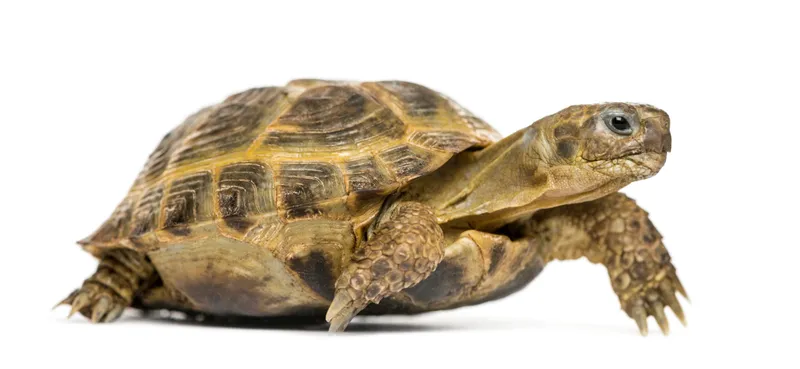
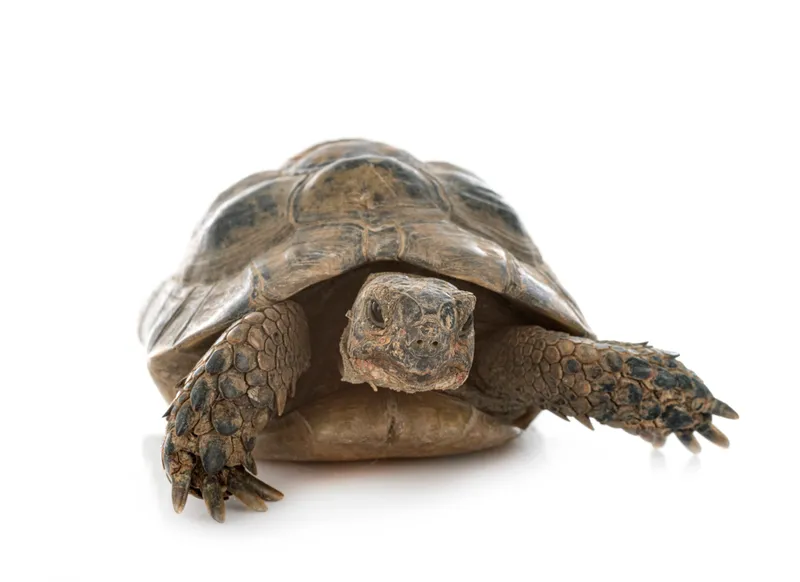
Greek tortoise
Testudo graeca
Ectothermic, poikilothermic reptile. Solitary in the wild; in captivity tolerates conspecifics in a large enclosure. Main behaviour: sun-basking thermoregulation, browsing and walking, hiding during midday heat, foraging substrate. More active and thermophilic than Hermann's tortoise.
Overview & key figures
Regulations
CITES Appendix II
ℹ️Keep/trade with proof of origin; CITES permits for import/export. OPAn: outdoor pen/UVB, managed hibernation; microchip marking recommended depending on size. Release prohibited.
Lifespan
from 50 to 100years
ℹ️50–100 years under good husbandry; some documented specimens > 100 years.
Adult weight
from 0.5 to 3kg
ℹ️Varies with subspecies and sex: T. g. graeca 0.5–1.5 kg; T. g. ibera (Anatolia) up to 3 kg. Females heavier than males.
Adult size
from 15 to 30cm
ℹ️Shell length: 15–20 cm (T. g. graeca), up to 25–30 cm (T. g. ibera).
Lifestyle
Mediterranean arid habitats, diurnal, terrestrial
Body temperature
Ectothermic / poikilothermic
Sexual maturity
from 7 to 11years
ℹ️7–8 years (males), 9–11 years (females).
Incubation
from 60 to 70days
ℹ️Incubation 60–70 days at 30–32 °C. Temperature-dependent sex determination (TSD).
Litter / clutch size
from 4 to 5eggs
ℹ️4–5 eggs per clutch, 2 clutches per year.
Habitat & environment
Type of housing
Natural outdoor enclosure all warm season (mid-April to mid-October depending on climate). Terrarium only for juveniles, convalescence or pre-/post-brumation. South-facing, perfect drainage.
Substrate & bedding
Outdoors: garden soil/sparse turf + slate slabs for basking; small leaf-litter spots for digging. Indoors: kitchen paper, newspaper or Sandmat Exoterra®. Avoid sand and fine soil indoors (intestinal impaction).
Lighting
Photoperiod : 10–12 h/day during activity; gradually shortened pre-brumation (8 → 6 h over 2–3 weeks). Outdoors the natural photoperiod is sufficient.
UVB
- UVB need : Vital indoors (vitamin D3 synthesis, calcium absorption); natural outdoors (>20 °C, sunny)
- Lamp type : Metal-halide lamps with external ballast (UVB + heat combined) or T5 HO 12 % tube with separate heat spot
- Recommended brands : X-ReptileReptile ExpertSolar RaptorArcadia
- Replacement : Yearly (metal-halide) — standard UV tubes every 6 months (UVB depletes before visible light)
- UVB does not pass through glass or plexiglass. Place the lamp inside the terrarium, under a protective grille. Direct sun behind a window pane is ineffective and may cause dangerous overheating.
- For the health of these reptiles, metal halide lamps are the gold standard for UV: they deliver a powerful UVB spectrum, far stronger than fluorescent tubes or compact bulbs, optimising vitamin D synthesis and therefore calcium absorption. They reduce the risk of metabolic bone disease, and also provide intense visible light and an even heat output that drive activity.
Basking : South-facing slate slab (outdoors) or metal-halide lamp at 30–40 cm distance (indoors). 30–35 °C at the shell surface.
Exercise & outings
Large outdoor grazing area for browsing, scratching, sun-basking and hiding. The Greek tortoise is very active and easily covers several tens of metres per day.
Required equipment
- ✓ Sturdy fence (concrete, treated wood or stone), ≥ 30 cm high, buried 20–30 cm against escape and digging predators
- ✓ Rounded corners (tortoises climb in corners)
- ✓ Covered shelter (hutch, cold frame) for rain and cold
- ✓ Sunny basking zone with slate slabs/stones
- ✓ Shaded areas under shrubs (summer thermal refuge)
- ✓ Shallow, wide water dish (5–8 cm), rough rim
- ✓ Edible plantings: dandelion, clover, sow thistle, hibiscus, mallow, plantain
- ✓ Cuttlebone free-choice
- ✓ Nesting box (moist sand/soil, half-sun) for females from 7–8 years
- ✓ Anti-corvid netting for juveniles
To avoid
- ⚠️ Fine sand / loose soil indoors (intestinal impaction)
- ⚠️ Hot rocks or floor heat plates (plastron burns)
- ⚠️ Unprotected UV lamps (burn risk)
- ⚠️ Glass between tortoise and UV (UVB does not pass through glass)
- ⚠️ Resinous wood shavings (pine, cedar) in large amounts
- ⚠️ Enclosure without permanent shade (summer heat stroke)
- ⚠️ Deep water dish (> 10 cm without ramp; drowning)
- ⚠️ Waterlogged ground (plastron mycoses)
Technical parameters
| Hot spot | 30–35 °C Basking spot under the lamp; temperature measured at the basking surface. |
| Cool spot | 18–25 °C Cool and night zone; tolerates down to 15 °C at night outside brumation. |
| Humidity | 40–60 % Rather dry (semi-desert origin); juveniles 50–60 % to prevent pyramiding. Avoid > 70 % (plastron fungi). |
Environmental hazards & toxins
Species that spend time free-roaming in the home or aviary can be exposed to these everyday hazards. Indicative list — check case by case.
Plants
- 🌸 Lily — Lilies of all varieties (bouquets, houseplants)
- 🌺 Oleander — Oleander (garden, balcony)
- 🌲 Yew — Common yew (hedges, gardens)
- 🔔 Lily of the valley — Lily of the valley (bouquets, garden)
- 🌸 Foxglove — Purple foxglove, ornamental plants
- 🌺 Rhododendron / azalea — Rhododendrons, azaleas (garden, ornamental plants)
- 🌸 Kalanchoe — Kalanchoes (popular houseplants)
- 🌸 Lantana — Lantana (ornamental plant, balconies)
- 🌿 Rhubarb leaves — Rhubarb leaves (garden)
- 🌳 Cherry laurel & Prunus species — Cherry-laurel hedges, leaves/stones of cherry, plum, apricot, peach (pruning thrown in the run)
- 🌸 Datura & deadly nightshade — Datura (angel's trumpet), deadly nightshade, black nightshade, henbane — weeds and ornamental plants
- 🌿 Hemlock — Poison hemlock, fool's parsley, water hemlock — ditches, wet meadows
- 🌸 Hydrangea — Potted and garden hydrangeas (popular blue/pink blooms)
- 🍁 Red maple (wilted leaves) — Wilted red maple leaves (autumn fall, prunings); especially toxic when dry
Chemicals
- 🐌 Slug bait (metaldehyde) — Blue slug pellets in gardens and vegetable plots
- 🌱 Herbicides & chemical fertilisers — Glyphosate, moss killer, fertiliser pellets, blood meal, bone meal; freshly applied baits/powders on lawn
- 🪰 Household insecticides — Fly sprays, mosquito diffusers, plug-ins, chemical antiparasitics
- 🐀 Rodenticides — Anticoagulants (warfarin, brodifacoum), bromethalin, cholecalciferol, strychnine; pellet/block baits, or poisoned dead rodents
- 🧂 Salt & salty water — Cattle salt licks, softener water, melted road-salt water, salty scraps (cold cuts, crisps)
Nutrition
Recommended breakdown
- Greens & wild herbs 90 %
- Fruit (occasional) 10 %
Daily base 90 %
Strict herbivore: 90 % varied fibrous greens (wild herbs, flowers, leaves), max 10 % fruit. Favour a high Ca/P ratio (≥ 2). Natural grazing in a planted enclosure is the ideal base. No animal protein.
🌿 Plants & herbs
🥕 Vegetables
🥕 Vegetables & greens
Supplemental plants and leaves to vary the grazing base.
⏰ Feeding frequency
- • Daily in active season (April to October), portion eaten within 15–20 min
- • 1–2 fasting days/week tolerated in adults (prevents obesity and pyramiding)
- • Gradual fasting from September before brumation
- • Calcium and cuttlebone permanently free-choice
- • Fresh water permanently available
Supplements & pellets
Tortoise herbivore pellets as occasional supplement, always rehydrated (prevents water deficit and improves chewing). Not as the staple.
- 🟤 Pellet — Réhydraté 5–10 min avant distribution
Treats 10 %
Fruit and sweeter plants in very small amounts (max 10 % of the diet). Favour vitamin-A-rich sources.
Hydration
Fresh water permanently in a wide, shallow dish, changed once daily. Lukewarm baths (28–30 °C, 15–20 min) weekly in active season, daily pre-/post-brumation. Tortoises drink mostly while bathing and from juicy plants.
Vitamin A
Essential for mucous membranes, skin, shedding and vision. Deficiency: puffy eyes, dysecdysis, respiratory/eye infections, poor shell quality. Covered by rich greens: dandelion (≈ 397,000 IU/kg DM), watercress (≈ 422,000), romaine (≈ 274,000), spinach (≈ 301,000), endive, turnip greens, kale, mango, papaya, apricot, melon.
To avoid
Toxic, severely unbalanced foods (poor Ca/P, sugar/starch-rich) or unsuitable for the strict herbivore. Animal protein is forbidden (gout, MBD, liver damage).
- 🥑 Avocado — Persine — cardiotoxique
- 🌿 Rhubarb — Acide oxalique
- 🍆 Eggplant — Solanine
- 🌼 Daffodil — Toxique
- 🌸 Azalea — Grayanotoxines
- 🌷 Tulip — Tuliposides
- ✨ Firefly — Mortel
- 🍄 Mushroom — Ca/P 0,06
- 🌽 Corn — Ca/P 0,1; amidon trop élevé
- 🥦 Brussels Sprouts — Ca/P 0,2; goitre
- 🍌 Banana — Trop sucré; Ca/P 0,3
- 🍅 Tomato — Acidité + Ca/P 0,4
- 🥬 Lettuce — Iceberg/ronde : trop d'eau, peu nutritive
- 🍑 Peach — Trop sucré
- 🍎 Apple — Trop sucré
- 🥒 Cucumber — Concombre : trop d'eau, Ca/P 0,5
- 🥦 Cauliflower — Goitre
- 🥕 Carrot — Trop sucré; Ca/P 0,6
- 🍇 Grape — Trop sucré
- 🍓 Strawberry — Trop sucré
- 🍓 Raspberry — À limiter
- 🍗 Chicken — Pas de protéine animale
- 🥩 Fatty meat — Pas de protéine animale
- 🧀 Dairy product — Inadapté
- 🍞 Bread — Inadapté
- 🍝 Pasta — Inadapté
Behaviour & socialisation
Social life
Solitary leaning; a male/female pair exposes the female to constant harassment (exhaustion, shell wounds). Prefer 1 male / 2–3 females or female-only groups. Separate males (territorial fights). Never cohabit with other tortoise species (Mycoplasma agassizii and herpesvirus transmission).
Activity cycle: Diurnal. Peak activity mid-morning (basking) then grazing; midday siesta in shade; second peak in the afternoon. At night, retreat to shelter or shallow burrowing.
Sleep & rest : No prolonged uninterrupted sleep in active season; retreats to shelter at night. The winter rest is shorter and milder than in Hermann's tortoise (brumation 6–10 weeks, 8–12 °C) — see Hibernation section.
Enrichment
- Grazing area planted with edible varieties to forage
- Leaf-litter / straw piles to bury in
- Stumps and stones to climb (safely)
- Weekly lukewarm bath (28–30 °C)
- Scattered food distribution to encourage walking
Foraging
Natural grazing behaviour: the tortoise walks, browses, scratches the ground and explores. Food scattered in the planted enclosure is the ideal enrichment — far more relevant than a heap in a dish. Promotes physical activity, sun exposure and digestive health.
Time in the wild : Several hours per day grazing and exploring (in active season)
Techniques :
- Plant dandelion, clover, plantain and hibiscus in the enclosure (spontaneous grazing)
- Scatter harvested greens in several spots rather than in a pile
- Hide favourite fruit under flat stones
- Vary weekly: shift the distribution zones
- Lukewarm bath + drinking: the animal also seeks its water
Health & prevention
Preventive medicine
Annual clinical exam (shell, nostrils, eyes, oral cavity, plastron, body condition), monthly weighing (trend curve), yearly faecal exam before brumation, microchip from ~10 cm shell length, quarantine ≥ 3 months for any new specimen (Mycoplasma agassizii and herpesvirus screening in at-risk animals). Annual UVB lamp replacement indoors. Wild-caught North African specimens are particularly prone to mycoplasmosis: PCR screening advised.
Vaccination
No routine vaccinations in the Greek tortoise.
Surgery & sterilisation
Common procedures: ovariohysterectomy for dystocia, shell wound care (fractures, predator injuries), cloacal/penile prolapse correction, abscess removal (notably aural abscesses), bladder stone removal (urates), shell repair with epoxy resin.
Clinical warning signs
If any of these symptoms appear, prompt veterinary care is essential. Contact an exotic-pet vet as soon as possible — they can assess your animal's condition and make the appropriate diagnosis.
Common conditions
Metabolic bone disease (MBD)
Cause: Calcium and/or UVB deficiency, excess fruit, unbalanced Ca/P, inadequate humidity in juveniles
Symptoms: Soft/deformed shell (pyramiding), soft beak, slow growth, spontaneous fractures, limb weakness
Prevention: UVB 10–12 % replaced yearly, free-choice calcium, high-Ca/P greens, age-appropriate humidity
Mycoplasmosis / Runny nose syndrome (RNS)
Cause: Mycoplasma agassizii or Mycoplasma testudineum (very common in T. graeca, especially North African specimens), chelonid herpesviruses, captivity stress, environment too cool/damp
Symptoms: Serous then mucopurulent nasal discharge, wheezing, appetite loss, conjunctivitis, often chronic
Prevention: Quarantine ≥ 3 months and Mycoplasma/herpes PCR for any new arrival, no mixing of tortoise species, strict hygiene, warm and dry environment
Dystocia / egg retention
Cause: No suitable nesting site, hypocalcaemia, oversized eggs, dehydration, stress
Symptoms: Anorexic female, > 1 week digging activity without laying, distended abdomen, penguin-gait
Prevention: Nesting box with moist sand/soil accessible all season, adequate calcium, hydration, yearly female check-up
Shell ulcers / mycosis
Cause: Substrate too damp or soiled, untreated wounds, parasitism (flies/maggots)
Symptoms: White/yellow/brown spots on plastron or carapace, progressive erosion, oozing, foul smell
Prevention: Dry, clean substrate (perfect drainage), regular cleaning, weekly shell check
Intestinal parasitism (pinworms, roundworms, flagellates)
Cause: Faecal re-infestation, poor hygiene, stress
Symptoms: Soft stools or diarrhoea, weight loss, growth delay, visible parasites in droppings
Prevention: Annual faecal exam (especially before brumation), targeted deworming, remove droppings regularly
Bladder stones (urates)
Cause: Chronic dehydration, excess protein, diet too dry
Symptoms: Anorexia, walking backwards, groaning, refusing baths, pasty urates
Prevention: Weekly baths, hydrated greens, no animal protein, water always available
Shell pyramiding
Cause: Growth too fast, too low humidity in juveniles, excess protein, lack of exercise
Symptoms: Dorsal scutes permanently raised in cones (irreversible deformation)
Prevention: 50–60 % humidity for juveniles, very fibrous diet, daily exercise, outdoor exposure as soon as possible
Aural abscess
Cause: Ascending from the Eustachian tube (poor hygiene, hypovitaminosis A, cold/damp environment)
Symptoms: Firm unilateral tympanic swelling (caseous material), often painless, sometimes anorexia
Prevention: Correct humidity, dietary vitamin A, environmental hygiene; surgical drainage when confirmed
Hibernation & rest
Good to know
Short, controlled brumation (6–10 weeks at 8–12 °C) rather than deep hibernation — key difference from Hermann's tortoise. Adapt to subspecies: T. g. ibera (Anatolia) tolerates colder/longer; T. g. graeca (Morocco/Spain) prefers a shorter, milder rest. Do not brumate: juvenile < 100–150 g, sick/convalescent animal, pre-brumation weight loss, or uncontrolled humid climate. Warning signs: repeated waking, nasal discharge, loss > 1 %/month or > 6–8 % total → interrupt and warm up gradually.
Period
October/November to January (6–10 weeks). Shorter and milder brumation than Hermann's tortoise.
Temperature
8–12 °C
Method
Cool dry room, polystyrene-insulated box at least 30 cm high, dry substrate (leaf litter/hay/newspaper), rodent protection. Reference weighing before entry. Do not hibernate in uncontrolled outdoor pits (T°/humidity fluctuations).
Step-by-step plan
- 1
Mid-August: adjust diet (high-fibre wild greens), limit fruit.
- 2
Early September: clinical exam + faecal; treat if parasites positive.
- 3
Mid-September: begin gradual fasting; daily 28–30 °C baths 10–15 min for 7–10 days before entry.
- 4
Entry (October/November): keep at 8–12 °C, quiet and dark room, dry ventilated substrate.
- 5
During brumation: monthly checks of weight (loss ≤ 1 %/month), T° and humidity.
- 6
Exit (January): raise to 18–22 °C over 7–10 days; baths 2–3×/week; gradual refeeding (fibrous herbs).
- 7
D+7 post-wake: consult if persistent feeding refusal, no urine output, loss > 10 %, or marked apathy.
Key indicator of a food's mineral balance, especially in reptiles (tortoises, lizards): a calcium-favoured ratio supports bone and shell strength and helps prevent metabolic bone disease. In herbivorous mammals, mineral balance is managed differently (hay, supplementation, UV light) — these targets don't translate directly.
For insects (crickets, roaches…), a calcium powder at feeding time can offset an unfavourable ratio.
- ≥ 2 — Adequate balance
- 1–2 — In moderation
- < 1 — Avoid / occasional only
This food is above the 50,000 IU/kg dry matter threshold, making it a good vitamin A source.
Content : — IU/kg DM
Essential for mucous membranes, skin, feathers and vision. Deficiency: respiratory infections, dysecdysis, eye problems, drop in laying.