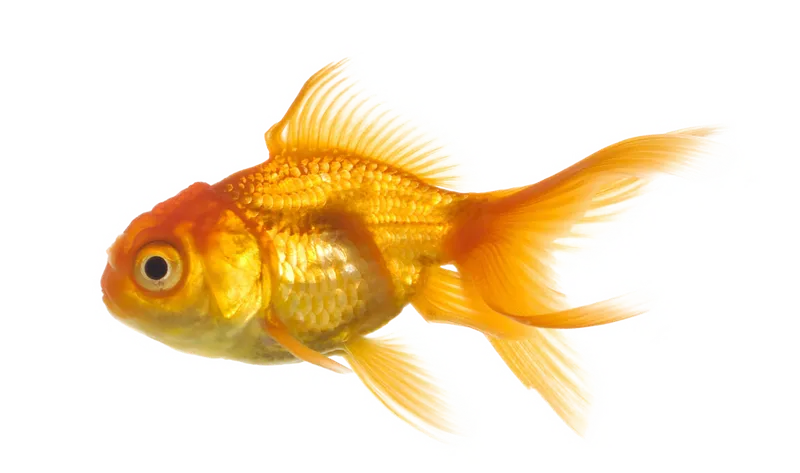
Goldfish
Carassius auratus
Gregarious, curious fish; active and object-manipulative; may nip inquisitively; sensitive to overcrowding stress.
Overview & key figures
Regulations
Ornamental fish, not CITES
ℹ️OPAn: fish standards (minimum volume, water quality; unsuitable bowls prohibited). Release to natural waters prohibited. Garden ponds subject to cantonal rules.
Lifespan
from 10 to 30years
ℹ️Median 12–15 years in captivity; selected strains or excellent care can exceed 20–30 years
Adult weight
from 100 to 3000g
ℹ️Highly variable by variety (common, comet, fantail, oranda), sex and body size
Adult size
from 15 to 35cm
ℹ️Standard length (SL) for common varieties in aquaria; in ponds some exceed 40 cm total length
Lifestyle
Diurnal, most active mornings/evenings
Sexual maturity
from 12 to 24months
ℹ️Depends on growth and seasonality; often 1–2 years under optimal conditions
Incubation
from 3 to 7days
ℹ️Eggs incubate at 20–24 °C (faster at 24–26 °C)
Litter / clutch size
from 500 to 3000eggs
ℹ️Highly size-dependent fecundity; multiple partial spawnings possible
Habitat & environment
Type of housing
Coldwater aquarium with high-capacity filtration, large volume, and high oxygenation
Substrate & bedding
Fine non-abrasive sand or bare-bottom; avoid ingestible sharp gravel.
Lighting
Photoperiod : 10–12 h/day
UVB
- UVB need : Not required
Moderate lighting; avoid heat build-up from fixtures.
Exercise & outings
Large open swimming area; enrichment via flow variations and exploration zones.
Required equipment
- ✓ Oversized filtration (5–10x tank volume/h) with ample bio-media
- ✓ Circulation/air pump (air stone) for high dissolved O2
- ✓ Regular water testing (NH3/NH4, NO2, NO3, pH, KH/GH)
- ✓ Thermometer; passive/active cooling in summer if >24–25 °C
- ✓ Robust plants and soft hides; secure lid
- ✓ Gravel vacuum for substrate maintenance and water changes
Technical parameters
| Cool spot | 14–18 °C Typical cool zone; wider tolerance with high O2 and low nitrogen waste. |
| Ambient temperature | 18–22 °C Ideal 18–20 °C; avoid sustained >24–25 °C. |
| ph | 7.0–8.0 (tolérance 6.8–8.2) |
| gh | 6–16 °dGH (modérément dur) |
| no2 | indétectable (0 mg/L) |
| no3 | <20–40 mg/L (idéalement <20) |
| nh4 | NH3 unionisée indétectable; NH4+ aussi bas que possible |
| po4 | aussi bas que possible; limiter charge organique |
Nutrition
Daily base
Opportunistic omnivore: goldfish-specific complete feed (pellets or gel) as the staple, supplemented with seaweed/greens. Sized to the mouth, ration precisely; amount eaten within <1–2 min.
🪵 Pellets
🍴 Other
🌿 Plants & herbs
🥕 Vegetables & greens
Fiber intake and prevention of constipation/swim bladder issues. Rinse and blanch 1–2 min; clip slices/leaves in place and remove leftovers after 12 h. Offer in small amounts, 1–2×/week.
⏰ Feeding frequency
- • Juveniles (growing): 2–3 small meals/day, eaten within <1–2 min
- • Adults: 1–2 small meals/day, eaten within <1–2 min
- • Fasting day: 1 day/week to limit obesity and water pollution
Supplements & pellets
Complete staple feed, 30–40% protein, 5–10% lipids, enriched with carotenoids and stabilized vitamin C (ideally ascorbyl-2-phosphate). Choose a size matched to the mouth.
- 🟤 Pellet — Carassius-specific formula
Treats
Occasional, in small amounts, for enrichment without unbalancing the diet. Thaw frozen items and rinse well before feeding.
Vitamin C
Essential vitamin C; use feeds with stabilized vitamin C; store dry and use within 3 months after opening.
To avoid
Human foods, starches and uncontrolled prey: digestive risks, nutritional imbalance and water pollution.
- 🍞 Bread — Gluten/starch unsuitable
- 🍝 Pasta — Starch not suited to fish metabolism
- 🥩 Fatty meat — Fatty meat/cold cuts; steatosis
- 🐁 Live prey — Uncontrolled prey (parasites/pathogens); prefer high-quality frozen alternatives
Behaviour & socialisation
Social life
Social species: keep in groups (≥3–5) with similarly sized conspecifics; avoid mixing with very small or long-finned species.
Activity cycle: Diurnal with activity peaks morning and evening; nocturnal rest when lights are off.
Enrichment
- Variable flow and exploration zones
- Safe floating/movable objects (rings, robust plants)
- Split feeding and foraging (scatter feeding)
- Safe-foraging substrate
Health & prevention
Preventive medicine
Quarantine new fish (≥30–45 days), parasite screening (skin/gill scrapes, fecal if feasible), system hygiene (water changes, substrate vacuuming), strict monitoring of water quality (NH3/NH4+, NO2−, NO3−, pH, KH, GH, temperature, oxygenation), balanced nutrition (high-quality complete diets, split feedings), biosecurity (tank-dedicated equipment).
Vaccination
No routine vaccinations
Surgery & sterilisation
Excision of cutaneous/gill tumors, swim bladder interventions (aspiration/pexia as indicated), foreign-body removal, wound debridement/closure, opercular deformity correction; bath anesthesia (tricaine/MS-222) with ventilation monitoring.
Clinical warning signs
If any of these symptoms appear, prompt veterinary care is essential. Contact an exotic-pet vet as soon as possible — they can assess your animal's condition and make the appropriate diagnosis.
Common conditions
White spot disease (Ichthyophthirius multifiliis)
Cause: Introduction without quarantine, water-quality/temperature stress
Symptoms: White spots on skin/fins, pruritus (flashing), respiratory distress if gills involved
Prevention: Quarantaine, stabilité thermique, UV stérilisation et bonnes pratiques d’hygiène
Costiasis/Trichodiniasis (Ichthyobodo/Trichodina spp.)
Cause: Organic loading, overcrowding, carrier introduction
Symptoms: Flashing, excess mucus, lethargy, congested gills, juvenile losses
Prevention: Gestion de la charge organique, quarantaines, entretien régulier
Flavobacterial diseases (Flavobacterium columnare/branchiophilum)
Cause: Warm water/high organics, stress, high density
Symptoms: Saddleback skin lesions, fin rot, necrotizing gill disease, respiratory distress
Prevention: Qualité d’eau optimale, réduction du stress, quarantaine
Ulcer disease – Aeromonas spp.
Cause: Opportunists thriving in poor water; wounds as entry points
Symptoms: Skin ulcers, hemorrhages, ascites/dropsy, lethargy, mortality
Prevention: Gestion de l’ammoniac/nitrites, manipulation douce, quarantaine
Gill myxobolosis (Myxobolus/Cysticola spp.)
Cause: Parasite–environment–host cycle in open systems/ponds
Symptoms: Labored breathing, pale/frayed gill lamellae, poor growth
Prevention: Filtration/UV, limitation des hôtes intermédiaires, biosécurité
Swim bladder disorders (buoyancy)
Cause: Swim bladder dysfunction, infections, compression by lipomatosis/tumors, aerophagia/inappropriate diet
Symptoms: Upside/side-floating, inability to stabilize, possible concurrent constipation
Prevention: Ration adaptée, éviter la suralimentation, qualité d’eau stable, sélection de souches à faible risque (formes moins extrêmes)
Ammonia and nitrite toxicity
Cause: Incomplete cycling, overfeeding, inadequate filtration, organic overload
Symptoms: Surface gasping, reddened/inflamed gills, lethargy, acute mortality
Prevention: Cyclage préalable, tests réguliers, changements d’eau, capacité de filtration adéquate