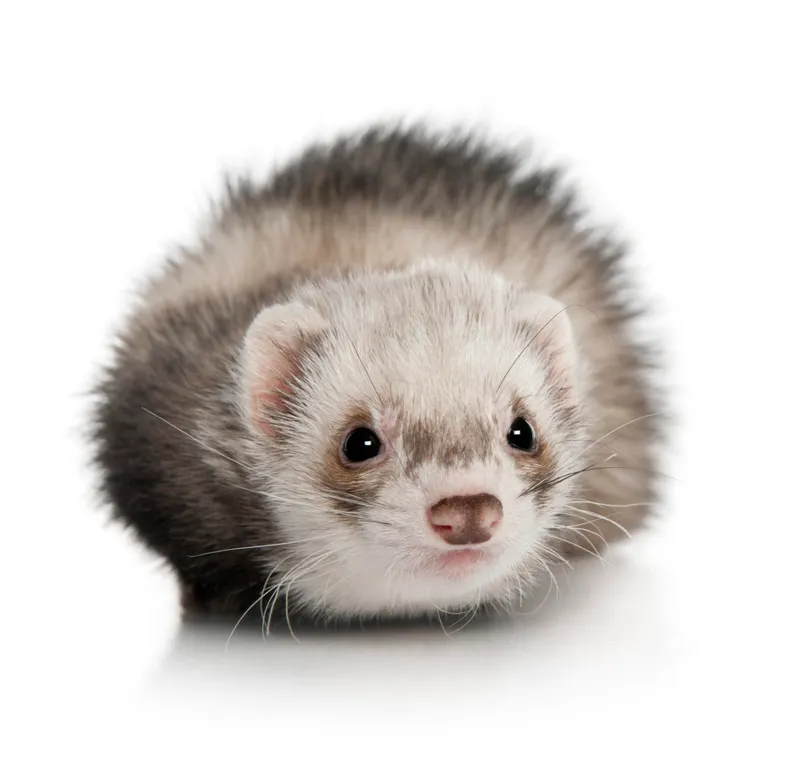
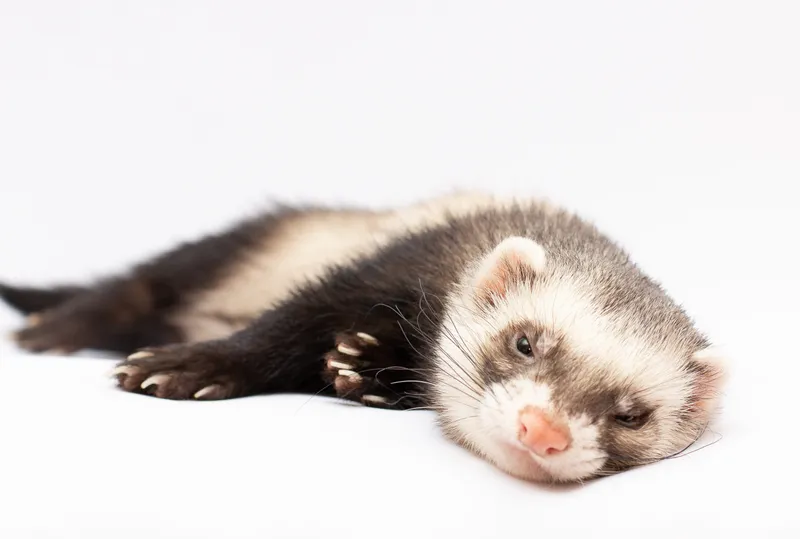
Ferret
Mustela putorius furo
Very social, curious, playful and destructive. Needs training to prevent biting.
Overview & key figures
Regulations
Companion animal
ℹ️OPAn: social housing recommended (pairs/groups), daily exercise time. Some communes require registration; rabies vaccine for travel. Release prohibited.
Lifespan
from 7 to 10years
Adult weight
from 0.6 to 1.5kg
ℹ️Male 800 g - 1.5 kg, female 600 g - 1 kg
Lifestyle
Diurnal (sleeps 15-16 hrs/day)
Body temperature
from 37.8 to 40°C
Sexual maturity
from 8 to 12months
ℹ️9 months (male), 8-12 months (female)
Gestation
from 39 to 42days
Litter / clutch size
from 1 to 18
ℹ️8 on average
Habitat & environment
Type of housing
Secured (ferret-proof) space of at least 4 m² for two animals
Substrate & bedding
Compressed paper (Yesterday's News®), plant-based bedding or cat litter (in a tray)
Lighting
Photoperiod : Limit to 12 h/day
Prevents adrenal disease.
Required equipment
- ✓ Hammocks
- ✓ Tunnels or plastic pipes
- ✓ Cosy beds
- ✓ Sturdy toys
- ✓ Food bowl
- ✓ Water bottle or heavy water bowl
Technical parameters
| Ambient temperature | 16–25 °C |
Nutrition
Strict carnivore and very much a creature of habit (dislikes food changes). Its diet must be rich in animal protein and fat but low in sugars, carbohydrates and fibre — free-choice day and night (short gut transit of 3-4 h).
Daily base
Lean raw meat, the base of a balanced home-made ration (recipes below): prevents many digestive and pancreatic problems. BARF (frozen ground meat and carcasses) is an alternative, as a base or supplement — a complete recipe is essential to avoid deficiencies, risk of bacterial contamination if poorly stored.
🥩 Proteins
Supplements & pellets
Ferret-specific kibble (>35% animal protein, 20-30% fat). Avoid kitten kibble (too high in carbohydrates, long-term health problems). Brands: Totally Ferret®, Supreme Science®, Marshall®.
- 🟤 Pellets — Ferret-specific
Treats
Whole prey (chicks, frozen rat or mouse) 1-3/day or as a treat; risk of bacterial contamination if poorly stored. Occasional treats (egg yolk, salmon, insect, ham…), without overdoing it.
To avoid
- 🍬 Sweets
- 🍫 Chocolate
Home-made ration: raw recipes for ferrets
After Dr G. Blanchart, Dr A. Linsart, Dr F. Modesto
A ferret needs about 200 calories per day per kilogram, with individual variation. Home-made rations allow precise control of the ingredients but require rigorous formulation and hygiene to avoid imbalances (notably Ca:P, taurine, iodine, vitamin E).
Chicken recipe
for 200 calories- 100 g lean chicken or turkey meat
- 7.5 ml rapeseed oil
- 0.5 ml fish oil (1 capsule opened onto one meal)
- 3 g (3/4 scoop) Vit'i5 Little Ca (powder, 10% Ca, vitamins and trace elements, no P), kneaded into the daily portion of meat
Chicken + fatty beef recipe
for 200 calories- 60 g chicken or turkey meat
- 50 g minced beef, 15% fat
- 5 ml rapeseed oil
- 0.5 ml fish oil (1 capsule opened onto one meal)
- 3 g (3/4 scoop) Vit'i5 Little Ca (powder, 10% Ca, vitamins and trace elements, no P), kneaded into the daily portion of meat
Supplement alternatives
- • Calcium + vitamins: carbohydrate-free carnivore premix (e.g. Felini Complete), high in Ca and low in P. Check iodine and taurine.
- • Calcium alone: calcium carbonate/citrate or eggshell; aim for Ca:P ≈ 1.2:1.
- • Taurine: powder or capsules; 250–500 mg/kg of ration.
- • Omega-3: fish oil (EPA + DHA) with vitamin E.
Important note
- • Preparation: all ingredients can be given raw, but the meat must be of good sanitary quality. Thoroughly mix the oil and Vit'i5 into the daily portion of meat or fish; half a pinch of salt (250 mg) can be added. A home-made ration is one and indivisible: prepare the mix for the day and keep it refrigerated, then serve small meals several times a day. You can also prepare the recipe for a week and freeze each daily portion (thaw gently in the fridge).
Behaviour & socialisation
Social life
Thrives in groups (3-4 ideally). Tolerates dogs and cats. Avoid prey species.
Activity cycle: Sleeps 15-16 hrs/day. Intense exploration when awake.
Enrichment
- Daily out-of-cage time
- Interactive play
- Ferret-proofed environment
- Food-hunting games
Health & prevention
Preventive medicine
Deworming: it depends on the ferret's lifestyle. A tailored deworming schedule is recommended, especially if it eats raw prey, with outdoor access, cohabitation with dogs or cats, or a raw-meat diet; the frequency should be set with your vet.
Vaccination
Canine distemper (very strongly recommended). Rabies (useful if the animal leaves the country).
Surgery & sterilisation
Neutering by implant from 7 months. Surgical neutering is irreversible, whereas the implant must be renewed periodically (4.7 mg: about 1.5 years on average; 9.4 mg: about 2.5 years). Recent studies show adrenal disease (adrenal gland tumour) appearing several years after surgery: the implant is therefore now strongly recommended and surgery should be avoided. If your ferret was surgically sterilised, we advise an ultrasound check of the adrenal glands.
Clinical warning signs
If any of these symptoms appear, prompt veterinary care is essential. Contact an exotic-pet vet as soon as possible — they can assess your animal's condition and make the appropriate diagnosis.
Common conditions
Hyperoestrogenism
Cause: An unmated female stays in continuous heat (oestrogen excess).
Symptoms: Hair loss, persistently swollen vulva, excessive itching and, eventually, bone-marrow destruction: the female becomes anaemic and can die quickly without appropriate treatment.
Prevention: Neutering of the non-breeding female (implant recommended).
Adrenal disease
Cause: Adrenal gland tumour, favoured by surgical neutering (on average 3.5 years after the operation).
Symptoms: Hair loss (tail, flanks), swollen vulva, hind-leg weakness.
Prevention: Prefer the implant to surgery; ultrasound check of the adrenal glands 3 years after surgical neutering.