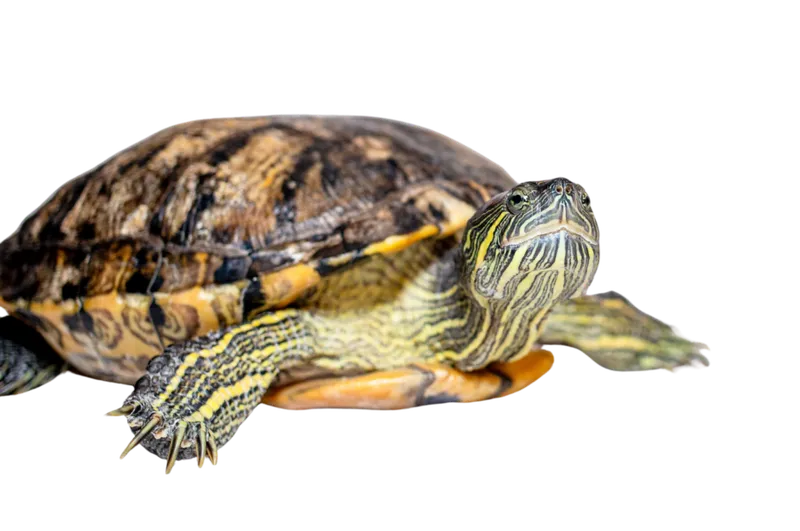
Aquatic turtle
Trachemys scripta
Semi-aquatic; alternates swimming and prolonged basking.
Overview & key figures
Regulations
Exotic species; Trachemys: invasive
ℹ️Trachemys scripta is listed as invasive alien in Switzerland (invasive species ordinance; release prohibited; holding/trade may face cantonal restrictions). Chrysemys picta not CITES-listed; Swiss OPAn: minimum enclosure/aquatic and UVB standards. Keep records of origin/trade.
Lifespan
from 20 to 40years
Adult weight
from 500 to 2000g
ℹ️Depending on species and sex; females often heavier
Adult size
from 12 to 30cm
ℹ️Plastron length depending on species/sex
Lifestyle
Diurnal
Sexual maturity
from 3 to 6years
ℹ️Often at 12-15 cm plastron length in female Trachemys
Incubation
from 55 to 75days
Litter / clutch size
from 5 to 20eggs
ℹ️Several clutches per year possible
Habitat & environment
Indoor habitat — aquaterrarium
Type of housing
Aquaterrarium with a deep water section and a dry basking area
Substrate & bedding
Water: bare bottom or rinsed fine sand; basking area: non-slip surface (cork/textured plastic). Avoid small ingestible gravel.
Lighting
Photoperiod : Cycle 10–12 h/day
UVB
- UVB need : Essential
- Lamp type : Metal-halide lamp over the dry basking platform
- Recommended brands : X-ReptileReptile ExpertSolar RaptorArcadia
- Replacement : Yearly (metal-halide) — standard UV tubes every 6 months
- UVB does not pass through glass or plexiglass. Place the lamp inside the terrarium, under a protective grille. Direct sun behind a window pane is ineffective and may cause dangerous overheating.
- For the health of these reptiles, metal halide lamps are the gold standard for UV: they deliver a powerful UVB spectrum, far stronger than fluorescent tubes or compact bulbs, optimising vitamin D synthesis and therefore calcium absorption. They reduce the risk of metabolic bone disease, and also provide intense visible light and an even heat output that drive activity.
Exercise & outings
Daily swimming in adequate water volume; moderate current with calm zones.
Required equipment
- ✓ Stable, fully dry basking platform
- ✓ UVB lamp + heat source (basking)
- ✓ Powerful external filtration
- ✓ Secured submersible heater
- ✓ Aquatic hideouts
- ✓ Water tests (pH, NO2, NO3, NH4, PO4), water/air thermometers
Technical parameters
| Hot spot | 30–34 °C Basking spot on the platform |
| Ambient temperature | 22–26 °C Water 24-26 °C for juveniles; 22-26 °C for adults; air temperature close to water temperature |
| ph | 6.8–7.8 (stable) |
| gh | Moyen (6–12 °dGH) |
| no2 | 0 mg/L |
| no3 | < 40 mg/L (idéal < 20 mg/L) |
| nh4 | 0 mg/L |
| po4 | < 0.5–1 mg/L |
Outdoor habitat — pond
Direct sun, more stable water and behaviours closer to the wild. Security, frost-free overwintering and water quality remain essential.
Pond and siting
- Sun 6–8 h/day with natural shade over 30–50% of the surface.
- 2–4 m² per adult; depth 80–120 cm with terraces (20–30 / 40–60 / 80–120 cm), slopes ≤ 30°.
- Clay base or EPDM liner 1 mm + geotextile underneath and on top.
Banks, basking and nesting
- Dry basking areas in full sun (dark slabs, logs, non-slip rafts); basking 30–35 °C.
- ≥ 1 m of free bank per individual; clear corridors to basking and nesting.
- Nesting site: 20–30 cm of drainable sand or soil above water level (mesh if breeding is unwanted).
Vegetation
- Submerged: elodea/egeria, Ceratophyllum, pondweeds.
- Floating: duckweed (Lemna), pistia (monitor spread).
- Banks & shade: yellow iris, cattails (Typha), rushes, sedges.
- Edible: water lettuce, Hydrocotyle, Sagittaria, hardy water lilies. No invasive species; pesticide-free.
Filtration and water quality
- Large volume = stability; external bio-mechanical filter 1.5–2× volume/h + lagoon area / filter plants.
- Summer aeration: air stone or waterfall.
- Maintenance: sediment siphoning, sponge rinsing in pond water, NO2/NO3/pH tests.
Safety
- Smooth perimeter fence 40–50 cm buried 15–20 cm, inward overhang on top; escape ramps all around.
- Predator defence: mesh or scarer cables against birds + rigid 10×10 mm mesh against mammals.
- Cohabitation: no large predatory fish.
Seasons, overwintering and monitoring
- Temperate: depth > 80–100 cm frost-free + bubbler/de-icer; stop feeding below 12–15 °C.
- Summer: shade and water turnover to avoid prolonged > 30 °C.
- Monitoring: water 22–28 °C, pH 6.8–8.0; watch appetite, basking and shell; isolate any abnormal animal.
Nutrition
Recommended breakdown
- Vegetables & aquatic plants 50 %
- Complete pellets 30 %
- Animal protein 20 %
Daily base
Opportunistic omnivore. The animal-protein/plant ratio shifts with age: juveniles and subadults eat 50–70% animal protein and 30–50% plant matter; adults gradually move to 50–80% plants and 20–50% animal protein. Portion size per meal: what fits in one to two head-volumes — no more. Overfeeding leads to obesity, fatty liver and shell pyramiding.
🪵 Pellets
🥕 Vegetables & greens
Aquatic plants grown in the tank (water lettuce Pistia, duckweed Lemna, elodea/egeria, pondweed, Hydrocotyle, Sagittaria, Ceratophyllum) plus fibre- and calcium-rich leafy greens floated or clipped to the side. Complement with land plants: mulberry/bramble leaves, nasturtium, mallow. Rinse thoroughly and grow without pesticides. Avoid unauthorised invasive species (e.g. water hyacinth).
⏰ Feeding frequency
- • Juveniles: every day (or small daily portions)
- • Subadults: every other day
- • Adults: 3–4 days/week, with "plants-only" days interspersed
- • Portion: what fits in one to two head-volumes per meal
- • Remove leftovers after 15–30 min to limit fouling
Supplements & pellets
Quality extruded pellets for aquatic turtles, specifically formulated Ca/P ≈ 2:1 with balanced D3 and A vitamins. Makes up 30–60% of the ration, alternated with fresh food. Soak for 5–10 min before feeding. Avoid cheap sticks high in starch and fat. Check expiry and store cool, away from light, to preserve vitamins A/D/E.
- 🟤 Aquatic turtle pellets — Complete diet; 30–40% protein (juvenile), 25–35% (adult)
Treats
Varied animal proteins, ideally fed whole (with viscera, bones, shell or carapace) to provide calcium and micronutrients. Gut-loaded insects dusted with calcium. Poultry liver or heart 1–2× per month in small amounts (preformed vitamin A). Mashed hard-boiled egg: rarely. Rotate sources to avoid monotony.
Hydration
The tank water must be clean, well filtered and kept at the target temperature (24–26 °C juvenile, 22–26 °C adult). Turtles hydrate by drinking and by eating aquatic plants. If a separate feeding tub is used, refresh the water at each meal.
Vitamin A
Essential for mucous membranes, skin, shell quality and vision. Deficiency: eyelid oedema, thick skin scales, conjunctivitis, stomatitis, respiratory infections, poor shell quality. Sources: vitamin-A-rich greens (dandelion, watercress, romaine, turnip greens, kale), whole prey (liver/viscera), balanced complete pellets. Avoid over-supplementation (toxicity). Caution: dried shrimp are very low in vitamin A and carotenoid precursors and quickly drive hypovitaminosis A.
To avoid
- 🥩 Fatty meat — Red meat or muscle poultry alone — unbalanced Ca:P; fatty or processed foods
- 🧀 Dairy product
- 🐟 Raw fish — Thiaminase-rich fish (carp, herring, anchovies) chronically without B1 supplementation — vitamin B1 deficiency
- 🥬 Iceberg Lettuce — Low nutritional value
- 🍞 Bread — Or human cereal products
- 📦 Processed food — Salty or sugary foods
- 🐠 Goldfish — Parasite and thiaminase risk
- 🦐 Dried shrimp — Very low in vitamin A and carotenoid precursors: quickly drive hypovitaminosis A
Behaviour & socialisation
Social life
Largely solitary; cohabitation to be assessed carefully (bites possible).
Activity cycle: Diurnal with daytime basking.
Enrichment
- Platforms and logs for basking
- Vary hideouts and current
- Prey-search activities (feeding enrichment)
Health & prevention
Preventive medicine
Adequate UVB and basking; water hygiene with established nitrification; quarantine for new arrivals; faecal exams depending on origin.
Vaccination
No standard vaccination recommendation
Surgery & sterilisation
Ovariectomy/ovariohysterectomy for dystocia/reproductive disease; shell surgery; removal of ingested objects.
Clinical warning signs
If any of these symptoms appear, prompt veterinary care is essential. Contact an exotic-pet vet as soon as possible — they can assess your animal's condition and make the appropriate diagnosis.
Common conditions
Nutritional osteodystrophy (MBD)
Cause: Calcium deficiency, inadequate UVB, unsuitable Ca/P ratio, hypovitaminosis D3
Symptoms: Shell softening/deformity, weakness, anorexia, growth delay
Prevention: Effective UVB, basking at 30-34 °C, balanced Ca-rich diet, Ca/P ratio >1
Bacterial respiratory disorders
Cause: Cold/dirty water, insufficient basking, hypovitaminosis A, opportunistic bacteria
Symptoms: Nasal discharge, wheezing, open-mouth breathing, asymmetric buoyancy
Prevention: Optimal water quality, appropriate temperatures and basking, adequate UVB, quarantine
Hypovitaminosis A
Cause: Diet poor in carotenoids/vitamin A
Symptoms: Eyelid oedema, thick skin scales, conjunctivitis, stomatitis, lethargy
Prevention: Balanced diet with dark-green vegetables and complete pellets; controlled supplementation if needed
Shell rot (shell dermatitis/mycoses)
Cause: Dirty water, trauma, opportunistic micro-organisms, insufficient basking
Symptoms: Soft patches, ulcerations, discolouration, odour, exudate
Prevention: Rigorous filtration/maintenance, accessible dry platform, correct basking/UVB
Internal parasites
Cause: Wild origin/contaminated food, no quarantine
Symptoms: Weight loss, abnormal stools, intermittent anorexia
Prevention: Quarantine, periodic faecal exams, targeted treatments if positive
Dystocia (egg retention)
Cause: No nesting site, hypocalcaemia, malformations, stress
Symptoms: Anorexia, restlessness, unproductive laying attempts, hindlimb oedema
Prevention: Appropriate nesting box, sufficient calcium/UVB, stress reduction
Hibernation & rest
Good to know
Three golden rules: (1) always fast 10–14 days before; (2) controlled temperature, no frost and no prolonged warm spells; (3) clean, well-oxygenated water if the turtle brumates in water.
Period
Temperate species (Trachemys, Chrysemys, Graptemys…) — not tropical ones. 8–12 weeks for adults, 6–8 weeks for a robust juvenile.
Temperature
4–8 °C
Method
Deep, well-oxygenated outdoor pond (surface kept partially ice-free), or a cool dark box / clean aerated cold-water tub. No feeding; water kept clean and well oxygenated.
Step-by-step plan
- 1
Prerequisite: turtle in good health, well fed and robust enough (usually not in its first year).
- 2
Autumn — gradually reduce the ration over 3–4 weeks, especially high-protein foods.
- 3
Autumn — gradually lower water temperature to 14–12 °C.
- 4
Stop feeding completely 10–14 days before brumation so the gut is empty.
- 5
Brumation set-up: 4–8 °C, stable and frost-free, in one of the two configurations (secure outdoor pond or controlled box).
- 6
During brumation: weigh weekly if possible (slight weight loss is normal, must stay moderate); check for absence of nasal discharge, abnormal smell or tilted floating.
- 7
Gradual wake-up: warm up over about a week to 22–24 °C, gradually switch lighting/UV back on.
- 8
Resuming feeding: small meals only after the turtle has drunk and eliminated, then gradually increase the ration.
Key indicator of a food's mineral balance, especially in reptiles (tortoises, lizards): a calcium-favoured ratio supports bone and shell strength and helps prevent metabolic bone disease. In herbivorous mammals, mineral balance is managed differently (hay, supplementation, UV light) — these targets don't translate directly.
For insects (crickets, roaches…), a calcium powder at feeding time can offset an unfavourable ratio.
- ≥ 2 — Adequate balance
- 1–2 — In moderation
- < 1 — Avoid / occasional only
This food is above the 50,000 IU/kg dry matter threshold, making it a good vitamin A source.
Content : — IU/kg DM
Essential for mucous membranes, skin, feathers and vision. Deficiency: respiratory infections, dysecdysis, eye problems, drop in laying.