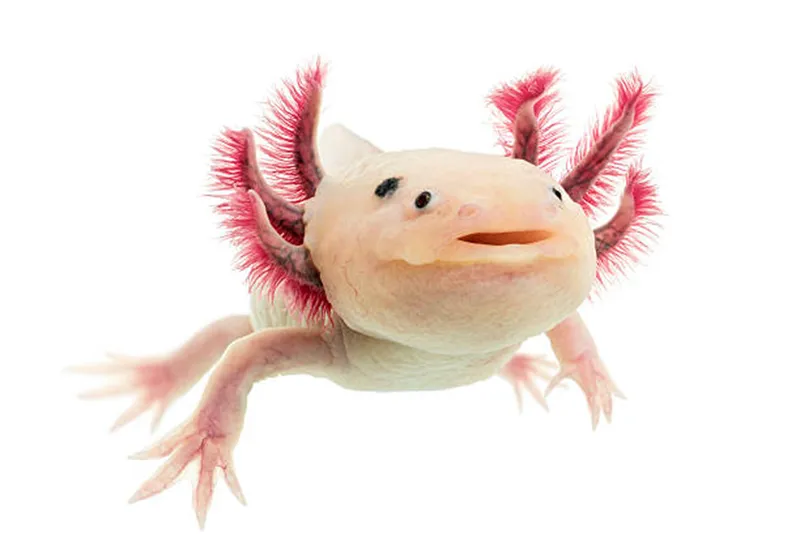
Axolotl
Ambystoma mexicanum
Permanent neoteny; branchial and accessory pulmonary respiration. Prefers calm waters and shaded areas. Sensitive to heat stress and currents.
Overview & key figures
Regulations
CITES Appendix II
ℹ️Captive-bred allowed with proof of origin; CITES permits required for import/export. Swiss OPAn: minimum standards for amphibians (water quality, temperature, stocking). Release strictly prohibited (invasive species rules).
Lifespan
from 10 to 15years
ℹ️Can reach 15 years in captivity, occasionally 20 years
Adult weight
from 60 to 150g
ℹ️80-120 g most commonly; giant morphs up to 200 g
Adult size
from 20 to 30cm
ℹ️Large individuals exceed 30 cm
Lifestyle
Crepuscular to nocturnal; sensitive to strong light
Body temperature
from 14 to 18°C
ℹ️Ectothermic; low thermal optimum (14-18 °C). >22-23 °C = heat stress.
Sexual maturity
from 9 to 18months
ℹ️Depending on size and temperature; males sometimes earlier
Incubation
from 10 to 14days
ℹ️At 18-20 °C; longer if water is colder
Litter / clutch size
from 100 to 800eggs
ℹ️Clutch size highly variable, 200-400 most common
Habitat & environment
Type of housing
Cool-water aquarium (cold freshwater, gentle flow)
Substrate & bedding
Very fine non-sharp sand (0.2-0.5 mm) in a layer <3-5 cm OR bare bottom. Avoid any gravel >0.5 mm (ingestion/impaction risk). Smooth decor.
Lighting
Photoperiod : Low to moderate, 8–12 h/day
Indirect light; avoid heating from the fixture.
Exercise & outings
Requires calm swimming space; avoid strong currents
Required equipment
- ✓ Chiller or fan with fine control (essential in summer)
- ✓ Mechanical and biological filtration sized at 3-5× volume/hour with broken outflow to limit current
- ✓ Water tests (NH3/NH4, NO2, NO3, pH, GH/KH)
- ✓ Smooth hideouts (PVC tubes, terracotta pots, smooth roots)
- ✓ Floating/shade plants (Lemna, Salvinia, Ceratophyllum)
- ✓ Lid (axolotls can jump)
Technical parameters
| Hot spot | 16–18 °C Ideal range 14-18 °C; tolerance 10-20 °C |
| Cool spot | 10–14 °C Seasonal cooling possible; avoid prolonged <8 °C |
| ph | 6.8 – 8.0 (idéal 7.2–7.6) |
| gh | 7 – 14 °dGH (modérément dur) |
| kh | 3 – 8 °dKH |
| notes | Cyclage complet du filtre 4–6 semaines avant introduction; changements 20–30%/semaine, eau à même température. |
| no2 | 0 mg/L |
| no3 | < 20 mg/L (idéal < 10 mg/L) |
| nh4 | 0 mg/L (ammoniaque non ionisée NH3 doit rester indétectable) |
| po4 | < 0.05 mg/L |
| conductivity | 200–600 µS/cm |
Nutrition
Daily base
Strict carnivore, prefers whole freshwater prey. High protein, moderate fat; avoid thiamine/calcium deficiencies.
🦗 Insects
🪵 Pellets
🥩 Proteins
⏰ Feeding frequency
- • Larvae <5 cm: 1-2 small meals/day
- • 5-10 cm: 1 meal/day or every other day
- • 10-15 cm: 3-4 times/week
- • 15-20 cm: 2-3 times/week
- • >20 cm (adults): 1-2 times/week
- • Adjust to temperature (less when water is cold). Remove leftovers to maintain water quality.
Supplements & pellets
Balanced sinking pellets, sized appropriately (6-8 mm for adults). Alternate with whole prey for enrichment.
- 🟤 Pellet — 2-4% of body weight per meal depending on frequency and temperature
To avoid
- 🥩 Mammal Meat — Poultry is unbalanced (high fat, micronutrient deficient); avoid.
- 🍗 Chicken — Same reason; risk of lipidosis/hyperphosphataemia.
- 🐠 Goldfish — Goldfish and some cyprinids are thiaminase-rich; risk of B1 deficiency and parasitoses.
- 🦐 Marine seafood — Salt/iodine inappropriate; possible osmotic imbalance.
Behaviour & socialisation
Social life
Cohabitation possible between similarly sized individuals; bite/amputation risk during feeding if overcrowded.
Activity cycle: Nocturnal/crepuscular; more active in low light.
Enrichment
- Multiple hideouts and shaded areas
- Targeted tong feeding to limit aggression
- Variety of smooth textures/decor
Health & prevention
Preventive medicine
30-45-day quarantine for new arrivals. Weekly water tests. Water changes 20-30%/week. Minimise handling; use moistened, gloved hands.
Surgery & sterilisation
Aquatic anaesthesia (buffered MS-222 100-200 mg/L) or sealed isoflurane baths; assisted ventilation for prolonged procedures; recovery in clean, isothermal water.
Clinical warning signs
If any of these symptoms appear, prompt veterinary care is essential. Contact an exotic-pet vet as soon as possible — they can assess your animal's condition and make the appropriate diagnosis.
First-aid steps
While waiting for veterinary advice, these steps can limit worsening. They don't replace a consultation and must be adapted to the situation.
- 1 Immediately measure NH3/NH4, NO2, NO3, pH and temperature
- 2 If overheated, gradually cool down (1-2 °C/hour) to 14-16 °C
- 3 Isolate in a cycled hospital tank with low flow
- 4 Remove ingestible substrates
Common conditions
Nitrogen-cycle disease
Cause: Toxic NH3/NO2 from incomplete filter cycling or biological overload
Symptoms: Lethargy, pale or reduced gills, respiratory distress, loss of appetite
Prevention: Fully cycle the tank 4-6 weeks before introduction; weekly water tests; 20-30%/week water changes
Skin and fungal infections (Saprolegnia)
Cause: Stress, injuries, deteriorated water quality or excessive temperature
Symptoms: Cotton-like white patches on skin or gills
Prevention: Maintain optimal cool water quality; systematic quarantine of new arrivals
Bacterial infections
Cause: Aeromonas, Pseudomonas - opportunistic on damaged skin
Symptoms: Skin ulcers, erythema, septicaemia, rapid mortality
Prevention: Strict tank hygiene, minimal handling with moistened gloved hands
Parasitoses
Cause: Protozoa and helminths introduced via uncontrolled prey
Symptoms: Weight loss, anorexia, digestive disorders, sometimes no visible signs
Prevention: Controlled food sources (healthy cultures) and quarantine of new arrivals
Gastrointestinal impaction
Cause: Accidental ingestion of gravel or substrate >0.5 mm
Symptoms: Anorexia, bloating, abnormal behaviour, mortality risk
Prevention: Use only very fine sand (<0.5 mm) or a bare bottom
Heat stress
Cause: Prolonged water temperature >20-22 °C (summer, chiller failure)
Symptoms: Anorexia, lethargy, weakened immunity, opportunistic infections
Prevention: Maintain 14-18 °C; chiller or fan in summer; daily checks during hot periods
Hibernation & rest
Good to know
In axolotls (Ambystoma mexicanum), ‘fridging’ (cooling to 5–8 °C) is not true hibernation and is not a routine practice. Reserve it short‑term (3–7 days, up to ~14) for heat/stress‑related anorexia, early gill fungus, or constipation/bloat, while addressing root causes (water quality/temperature). Key parameters: cool, stable water 14–18 °C (ideal ~16 °C), undetectable NH3/NH4+ and NO2–, NO3– <20–40 mg/L, pH ~7.0–7.6, high oxygenation, low flow, ample hides. Contraindications to fridging: severely debilitated animals, suspected systemic infections, extensive open wounds (prefer hospital tank at ~16 °C with pristine water). If used: gradual acclimation 1–2 °C/hour to 8–10 °C, bare hospital tub, daily conditioned water changes, monitor gills/appetite; then warm back to ~16 °C gradually. Avoid >20–22 °C, ingestible substrates (fine gravel), and aggressive co‑housing.
Temperature
10–14 °C
Method
Cycled hospital tank, 10-14 °C, low light; monitor NH3/NO2; gentle aeration; gradual return to 14-18 °C.
Step-by-step plan
- 1
Test and prepare cycled water at 12-14 °C
- 2
Acclimation at 1-2 °C per hour
- 3
Daily monitoring of parameters and appetite
- 4
Short duration (days to weeks) depending on indication
- 5
Gradual rewarming 1-2 °C every 12-24 hrs