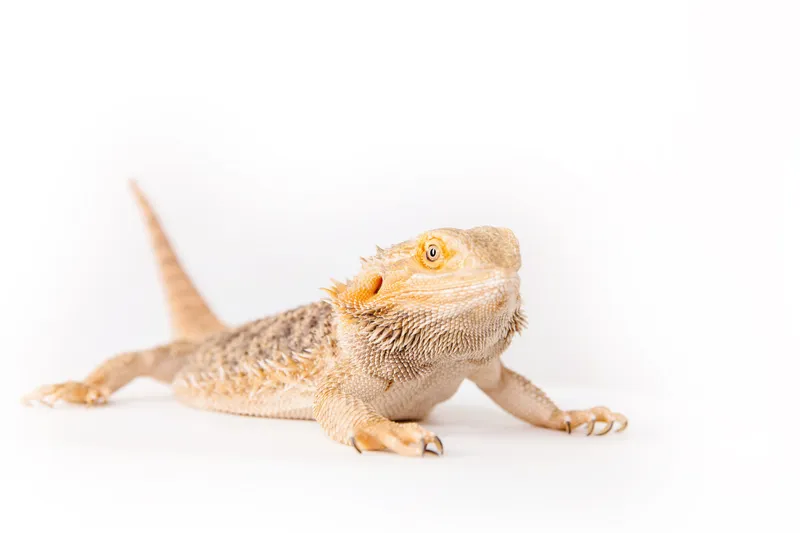
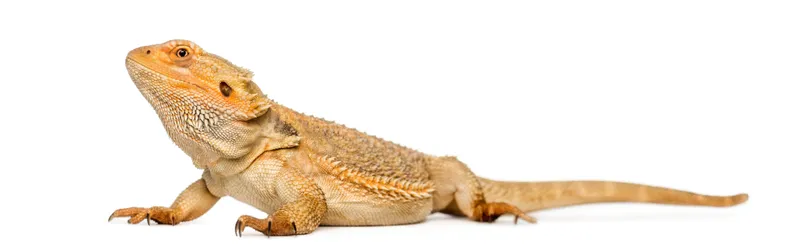
Central bearded dragon
Pogona vitticeps
Generally docile, curious lizard with marked communication behaviours: head-bobbing in the dominant male, slow arm-waving in the female or subordinate, puffing of the black ‘beard’ when stressed or displaying.
Overview & key figures
Regulations
Not CITES-listed
ℹ️OPAn: minimum standards for diurnal reptiles (mandatory UVB, heat gradient, enclosure sizes). Keep records; release prohibited. Professional trade requires competence per Swiss rules.
Lifespan
from 8 to 10years
ℹ️Median 8–10 years; up to 12–15 years with excellent husbandry.
Adult weight
from 300 to 500g
ℹ️Males slightly heavier; obesity common in captivity.
Adult size
from 38 to 60cm
ℹ️Total length (snout + tail); the tail accounts for ~50% of total length.
Lifestyle
Semi-desert, semi-arboreal, diurnal
Body temperature
Ectothermic / poikilothermic
Sexual maturity
from 0.5 to 1.5years
ℹ️30 cm; 6 months for males, 10–18 months for females
Incubation
from 21 to 42days
ℹ️Incubation 3–6 weeks depending on temperature (28–30 °C).
Litter / clutch size
from 10 to 40eggs
ℹ️10–40 eggs/clutch (soft-shelled); 2–7 clutches per year.
Habitat & environment
Type of housing
Spacious, dry terrarium with strong UVB lighting. Two mandatory thermal zones (basking / cool). Materials easy to clean and heat-retaining (glass, plastic, plexiglass). Bilateral ventilation essential (front + sides or back).
Substrate & bedding
Sandmat Exoterra®, kitchen paper or newspaper. Avoid sand and soil (risk of intestinal impaction).
Lighting
Photoperiod : 14 h/day
UVB
- UVB need : Vital
- Lamp type : Metal-halide with external ballast (UVB + heat combined)
- Recommended brands : X-ReptileReptile ExpertSolar RaptorArcadia
- Replacement : Yearly (metal-halide) — standard UV tubes every 6 months (UVB depletes before visible light)
- UVB does not pass through glass or plexiglass. Place the lamp inside the terrarium, under a protective grille. Direct sun behind a window pane is ineffective and may cause dangerous overheating.
- For the health of these reptiles, metal halide lamps are the gold standard for UV: they deliver a powerful UVB spectrum, far stronger than fluorescent tubes or compact bulbs, optimising vitamin D synthesis and therefore calcium absorption. They reduce the risk of metabolic bone disease, and also provide intense visible light and an even heat output that drive activity.
Exercise & outings
Large floor area for crawling, branches for climbing, supervised outings outside the terrarium in a safe environment.
Required equipment
- ✓ Branches/roots for climbing and basking
- ✓ Hides on both warm and cool sides
- ✓ Flat basking stone under the lamp to aid digestion
- ✓ Lateral ventilation (front or sides)
- ✓ Shallow water dish (rarely used)
- ✓ Pipette/syringe for hydration 2–3×/week
- ✓ Weekly bath / gentle lukewarm shower
To avoid
- ⚠️ In-terrarium heat plates
- ⚠️ Hot rocks
- ⚠️ Heat mats inside the terrarium
- ⚠️ Lamps without protective grille (burn risk)
Technical parameters
| Hot spot | 35–40 °C Basking spot; flat stone or branch under the lamp. |
| Cool spot | 20–25 °C Cool zone; same temperature at night (no night heating). |
| Humidity | 30–40 % Dry; sufficient ventilation to prevent condensation. |
Nutrition
Daily base
Opportunistic omnivore; diet changes with age. Hatchlings (<5 months): 60–80% insects. Adults: 60–80% plants. Key rules: prey size ≤ head width between the eyes (paralysis/impaction risk); insects must be gut-loaded for 24–48 h (calcium-rich greens, fruit, species-specific feed) before feeding, otherwise nutritional value collapses; vary sources to cover vitamins and minerals.
🦗 Insects
🥕 Vegetables & greens
Favour greens with a high Ca/P ratio and rich in vitamin A. Chop finely, vary sources, remove leftovers after 12 h.
⏰ Feeding frequency
- • Hatchlings (<5 months): 3 meals/day (60–80% insects); e.g. 9 am: 4 crickets; 12 pm: chopped greens; 5 pm: 1 silkworm + 2 crickets
- • Juveniles (5–18 months): 1 meal/day, gradual shift toward greens
- • Adults: daily (60–80% greens), insects 2–3×/week
- • 1 fasting day/week for adults to limit obesity
Treats
Occasional treats, in small amounts. Fatty insects and pinkie mice: limit to avoid obesity and hepatic lipidosis.
Hydration
The water dish is rarely used. Prefer pipette watering (droplets on the snout) 2–3×/week, a weekly lukewarm bath (water up to the elbows, ~20 min) or light misting of greens. Fresh greens cover much of the hydration needs.
Vitamin A
Vitamin A essential for mucous membranes, skin and vision. Favour natural sources (dark leafy greens, watercress, dandelion, parsley, romaine) over supplements. Deficiency: puffy eyes, dysecdysis, recurring infections.
To avoid
Toxic, severely unbalanced or parasite-risk foods. Strictly avoid.
- 🥑 Avocado — Toxic (persin); cardio- and hepatotoxic
- 🌿 Rhubarb — Very high in oxalates; nephrotoxic
- 🍆 Eggplant — Solanine; potentially toxic
- 🌼 Daffodil — Toxic (alkaloids)
- 🌷 Tulip — Toxic (tuliposides)
- 🌸 Azalea — Highly toxic (grayanotoxins)
- ✨ Firefly — Lethal (lucibufagins, even in tiny amounts)
- 🐛 Caterpillar — Toxicological risk (urticating hairs, alkaloids)
- 🦋 Butterfly — Often toxic (alkaloids from host plants)
- 🐾 Wild-caught prey — Uncontrolled wild prey (parasites, pesticides)
Behaviour & socialisation
Social life
Solitary as adults. Male/male cohabitation forbidden (fights, serious injuries). Pair 1 male / 1 female: risks exhausting the female. 2 females or 1 male / 2 females tolerated with enlarged terrarium (+30%), multiple basking spots and constant monitoring.
Activity cycle: Diurnal; peak activity around midday during basking. Nocturnal rest inside a hide or perched on a branch.
Enrichment
- Hunting live insects (moving prey)
- Varied vertical setup: branches, roots, basking platforms
- Supervised outings outside the terrarium in a safe environment
- Weekly bath or gentle lukewarm shower
- Various greens served as small scattered piles
Health & prevention
Preventive medicine
Annual clinical exam (general condition, shedding, oral cavity, abdomen, masses), regular weighing (weight trend), yearly faecal exam (internal parasites), annual UVB lamp replacement, monitoring of thermal gradient and humidity, weekly bath for skin hydration.
Vaccination
No routine vaccinations.
Surgery & sterilisation
Common procedures: ovariohysterectomy for dystocia (egg retention), excision of cutaneous/abdominal masses, removal of digestive foreign bodies, wound debridement and closure, partial tail amputation (necrosis), correction of prolapse (cloacal, hemipenis).
Clinical warning signs
If any of these symptoms appear, prompt veterinary care is essential. Contact an exotic-pet vet as soon as possible — they can assess your animal's condition and make the appropriate diagnosis.
Common conditions
Metabolic bone disease (MBD)
Cause: UVB and/or calcium deficiency, low dietary Ca/P ratio, lack of vitamin D3
Symptoms: Soft jaw, bone deformities, spontaneous fractures, tremors, weakness, prostration
Prevention: UVB 10–12% replaced annually, regular calcium supplementation, greens with high Ca/P
Dystocia / egg retention
Cause: Lack of suitable nesting site, hypocalcaemia, oversized eggs, obesity, dehydration
Symptoms: Lethargic gravid female, distended abdomen, ineffective contractions > 48 h, anorexia
Prevention: Nesting box (moist sand/soil) from maturity, adequate calcium, optimal body condition, veterinary follow-up
Internal parasitism (coccidia, pinworms)
Cause: Faecal re-infestation, poor hygiene, stress, overcrowding
Symptoms: Diarrhoea, weight loss despite preserved appetite, growth delay in juveniles
Prevention: Annual faecal exam, frequent removal of droppings, quarantine of new individuals
Atadenovirus (BDPV / agamid adenovirus)
Cause: Horizontal (faecal) and vertical transmission; asymptomatic carriers common
Symptoms: Juvenile mortality, hepatitis, growth retardation, anorexia, paresis
Prevention: Quarantine ≥ 90 days with cloacal PCR, strict biosecurity, exclude contaminated breeding lines
Yellow Fungus Disease (Nannizziopsis guarroi)
Cause: Opportunistic keratinophilic fungus, immunosuppressed host, inappropriate humidity
Symptoms: Yellow/brown crusty skin patches, deep ulcerations, necrosis, systemic spread
Prevention: Strict hygiene, quarantine of new individuals, stress and humidity management
Thermal burns
Cause: Hot rocks, in-terrarium heat plates/mats, lamps without protective grille
Symptoms: Sharply demarcated ventral/dorsal lesions, incomplete shedding over the area, secondary infection
Prevention: Heat source out of reach, protective grille, thermal gradient external to the substrate
Dysecdysis (retained shed)
Cause: Low humidity, vitamin A deficiency, dehydration, external parasites
Symptoms: Retained skin flaps on toes/tail, possible distal necrosis (shed ring)
Prevention: Weekly bath, correct humidity, vitamin-A-rich greens, gentle removal of remnants
Ulcerative stomatitis (mouth rot)
Cause: Stress, oral trauma, poor hygiene, immunosuppression
Symptoms: Caseous deposits in the mouth, bleeding gums, hypersalivation, anorexia
Prevention: Terrarium hygiene, correct thermal parameters, regular oral check
Key indicator of a food's mineral balance, especially in reptiles (tortoises, lizards): a calcium-favoured ratio supports bone and shell strength and helps prevent metabolic bone disease. In herbivorous mammals, mineral balance is managed differently (hay, supplementation, UV light) — these targets don't translate directly.
For insects (crickets, roaches…), a calcium powder at feeding time can offset an unfavourable ratio.
- ≥ 2 — Adequate balance
- 1–2 — In moderation
- < 1 — Avoid / occasional only
This food is above the 50,000 IU/kg dry matter threshold, making it a good vitamin A source.
Content : — IU/kg DM
Essential for mucous membranes, skin, feathers and vision. Deficiency: respiratory infections, dysecdysis, eye problems, drop in laying.